Tuesday, May 06, 2008

Spring Ephemerals: Virginia Bluebells Are Spreading Through The Garden


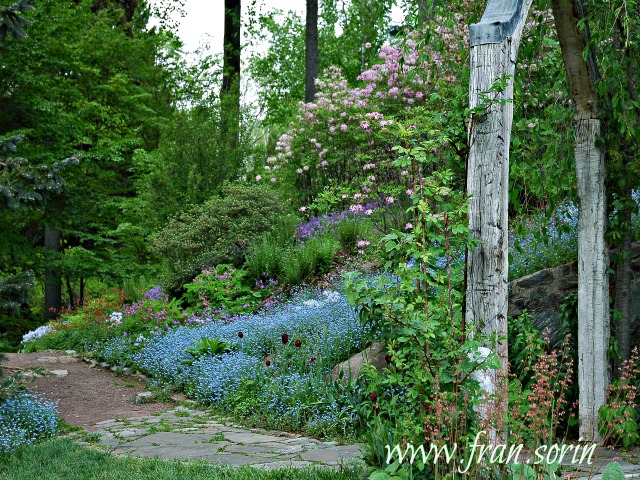
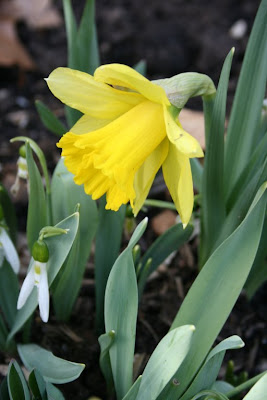
This year, my Virginia Bluebells are the best ever. After three seasons, these spring ephemerals are spreading beautifully through the garden. I have wonderful combinations of them with daffodils (pictured) in the Long Border and great surprises as they have shown up in other areas.
~
I look forward to their number increasing further. The spring ephemerals are so charming for how they appear when the garden is bare and leave in just enough time to make room for summer perennials as they bulk up.
~
In my garden, more bluebells are always welcome. They seem to thrive in areas where the clay soil is on the dry side and in parts where the moisture level is more normal. They have done well in rich and ordinary soil. I have them planted under roses, a tree hydrangea, and in the 'tree skirts' that surround my oaks in the back garden.

Monday, May 05, 2008

Advice Wanted: Crown Imperial Fritillaria Coming up Blind

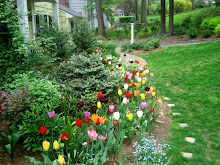
Last year I planted various orange and deep purple tulips and orange fritillaria in the Rose Garden. I love orange tulips and the contrast with the deep purple makes the orange stand out all the more. I thought the orange crown imperial fritillaria would be great with the tulips.

~
The bulbs all came up beautifully. But THEN, only one fritillaria formed flowers. Why? So far, I have no quick answers. I spoke to a gardener at one of the botanical garden I visit who suggested buying the bulbs from a different supplier. They have hundreds of fritillaria which are all blooming from Brent & Becky's.
~
~
Any other ideas? The one (pictured) is so beautiful, I would love to have more next spring.

Friday, May 02, 2008

Vegetable Gardening with Children: How to Plant Potatoes and First Harvest of the Season - Asparagus

While my less-than-half-an-acre suburban lot is primarily a flower garden, I do enjoy growing the vegetables and herbs for which I have room. A few years ago, I visited the working organic farm at Old Sturbridge Village in Massachusetts and learned that it would take approximately one acre to feed my entire family of seven for the year. Thus, rather than trying to feed my family, the vegetables and herbs primarily provide an opportunity for my children's participation and education. We get to organically prepare the soil, plant the seeds or seedlings, and then harvest the results. Further, we get to plant heirloom varieties that are otherwise not available. In terms of yield, we produce enough for the occasional amuse-bouche or side dish. To satisfy our need for organic and locally harvested produce, we shop at the local farmers' markets in Chatham and Summit from June through November.
~
Last week, according to the Old Farmer's Almanac, it was time to plant our seed potatoes. This is a perfect activity to do with children, or if old enough to handle a sharp knife, something that the children can do by themselves with some adult supervision. First, our son (age eight) prepared our seed potatoes (purchased from Seed Savers Exchange) by cutting them into one inch pieces. Second, we cured them cut-side up for three days to prevent them from rotting in the soil. Third, we planted them an inch-or-so in the raised vegetable bed with the eyes up.
~
Three years ago, we planted our first asparagus crowns (purchased from the Cook's Garden) around the outside of the Children's Garden. This weekend, we got our first harvest--three big, beautiful stalks of asparagus (pictured). The kids were so excited to cut the asparagus (about one inch above the ground), roast it, and then eat it with dinner. In the coming weeks, we'll have more to harvest.
~
Related posts: Ten Tips for Planning a Children's Garden, How to Build Raised Vegetable Beds, Old Farmer's Almanac Spring Planting Schedule

Wednesday, April 30, 2008

Garden Bloggers' Design Workshop: Heirloom Gardener's Four Year Makeover of Her Front Garden - How to Improve Boring Suburban Landscaping

April's Garden Bloggers' Design Workshop on Front Yard Gardens is very timely for me seeing that my spring project was to complete the four year redesign of our front garden, which is made up of the Front Border immediately in front of the house and, standing in front of the house to the immediate left, the Egg Garden.

When we moved into our house, the front garden had the usual foundation plantings: evergreen trees and shrubs with two flowering trees for color. It was dull, static, and uninspiring. The first three pictures show the front border before I began replanting it.
.
.
.
.
.
.
.
.
.
.
.
.
.
To my neighbors' amazement, I proceeded to take out the whole thing and replant it myself. The first year, I replanted the existing borders and created the Egg Garden. The existing borders had three problems: they did not change with the seasons--summer looked the same as fall and spring, and winter was only slightly different; some of the plants had grown so large that they covered windows and were out of proportion with the house; and the borders needed very little maintenance which meant there was little gardening to be done.
~
I started by removing the large problem plants: the huge rhododendron which was out of proportion with our two-story colonial, the two amorphous evergreen cones flanking the front door, and a weeping cherry which obscured the windows of the library. Then I took away anything that was poorly suited for the site, like the leucothea in full sun, or that did nothing for the border, like a deformed Ceris 'Forest Pansy.' Next, I improved the soil by adding four inches of mushroom compost. Finally, I began replanting with small trees, shrubs, perennials, annuals, vines, grasses, and bulbs. I also added a bird feeder.
~
The Egg Garden was created almost entirely from the space that was formerly occupied by the rhododendron and is bordered in the back by the fence and arbor that enclose the Cutting Garden. Small six-by-six stepping stones through the grass connected the front walkway to larger, but not large enough, twelve-by-twelve inch stepping stones through the Egg Garden to the Cutting Garden.


.
.
.
In the second year, I expanded both the Front Border and the Egg Garden, and spent time planting both more densely. I also decided to remove the bird feeder which seemed more appropriate in the backyard. In its place, I installed a tutuer on which I decided to grow the rose Lavender Lass and clematis Blue Bird and Francesca.
.
.
.
.
.
.
.
.
.
.
.
.
.
.
.
In the third year, I added a large pot and a semi circular boxwood hedge in front of the library, to give that area definition and a focal point. In the Egg Garden, I widened the path and replaced the twelve by twelve inch stepping stones with loose gravel. As always, I looked for ways to expand the floral display with more bulbs, clematis, and annuals.
.
.
.
.
.
.
.
.
.
.
.
.
.
.
.
This year, I am completing the final phase of the front border renovation. I replaced the old path of brick pavers with a wider one of irregular blue stone to compliment the other stone work in the garden. I also continue the blue stone stairs on the other side of the driveway. Previously, the steps took you from the mailbox to the driveway through Goldberry Hill. From there, you were expected walk down the driveway and then onto the entrance of the path leading to the front door. No one did this, not even me. One of the cardinal rules of my garden is that there should be paths where people walk.
~
Further on, in place of the small six by six inch stepping stones that connected the front path to the Egg Garden, there are now more appropriately sized two by two foot blue stones. Throughout, I chose irregular blue stone pieces to harmonize with the less formal plantings.
~
The borders in the front were also to be expanded to flank each side of the new stairs. I wanted continuity in plantings around the new steps and those already there, so that it would not be obvious that they were installed at two different times. I chose to use the same plants or plant types so that the steps would echo each other.
~
The project is just about complete now. I will have to see how the plants grow in before I add more to the new plantings. In the fall, I will plant more spring blooming bulbs.


Thursday, April 24, 2008

Advice Wanted: How to Keep Rabbits Out of the Garden

I need some help and advice from my fellow gardeners. I have always had the occasional rabbit in the garden, but nothing too damaging. This year, I have a rabbit infestation and he or she is eating everything in sight. I wasn't sure who the culprit was, but then I saw the rabbit shamelessly eating my new plants in broad daylight. From what I've read, it seems that the options are guns (not practical in the suburbs), fences, traps (my husband's weekend assignment), dogs/cats (not an option right now), and repellents (I am currently spraying both commercial and home-made repellents). Some gardeners on GardenWeb also suggested spreading human hair, sprinkling pepper, and planting plants they do not like, such as nepeta (catmint). Does anyone have insight into which of these or additional suggestions will work?

Update April 25, 2008: May Dreams Gardens has a lot of experience with rabbits and suggests sprinkling cayenne pepper on the plants that need protection.

Update May 10, 2008: Thank you all for the suggestions--some of them are working. First, I sprinkled the cayenne pepper on the most susceptible plants and the rabbits are staying away from them. Second, I captured my first rabbit in a rabbit trap baited with one of their favorite foods--clover.

Related posts: Keeping Groundhogs Out of the Garden, Keeping Deer Out of the Garden

Thyme for Herbs: 10 Blogs That Have Raised The Bar On Garden Blogging

I was surprised and honored to be recognized by Jane Marie at Thyme of Herbs in her list of "10 Blogs That Have Raised The Bar On Garden Blogging." Janie Marie, thank you for your support and recognition!

Related post: Heirloom Gardener Featured on the Star-Ledger's NJ.com

Wednesday, April 23, 2008

A Visit to Chanticleer in Wayne, Pennsylvania: Spring Bulbs, Flowering Trees, and Inspiring Containers

I have never been to Chanticleer in the spring. Usually, things are too busy here with spring sports and gardening to go for the day; but with a clear schedule, we went. It was wonderful.

The most inspiring part of the visit was seeing all the containers. I often find spring pots hard to put together, but with a combination of colored branches from dogwoods and willows, climbing vines, leafy vegetables, and some flowering plants, each pot conveyed the fun and excitement of spring.
It was also good to see which annuals be set out early. Usually, I plant bulbs for most of my spring color in my beds, but I was inspired by Chanticleer to use some annuals such as the African daisy (Osteospermum) which can tolerate cool weather too.
Chanticleer's large drifts of bulbs (pictured) are a hint to the abundance of summer which will follow. I have not planted any bulbs in the lawn, but I'm thinking of doing so in the fall. My daughter loved that you could walk through the flowering bulbs as if they created a meadow. It is those kinds of romantic vignettes that make Chanticleer memorable.
In this trip, I was also able to see things which are more hidden later in the season. To see how hard they cut back their shrubs teaches me how much to cut mine back. I wanted to much a hill in our garden with pebbles, but I hesitated thinking that they would roll down. However, at Chanticleer there is a hill as steep or steeper than mine mulched with pebbles (pictured) and they are not all sitting at the bottom of the hill.

Tuesday, April 22, 2008

Wall Street Journal & New York Times: Suburban Farming and Kitchen Gardens

Today, the Wall Street Journal featured an article and a video about individuals who have started to farm their own and their neighbors' suburban lots for food. Kelly Spors writes:

"Since 2006, Mr. Nash, 31, has uprooted his backyard and the front or back yards of eight of his Boulder neighbors, turning them into minifarms growing tomatoes, bok choy, garlic and beets. Between May and September, he gives weekly bagfuls of fresh-picked vegetables and herbs to people here who have bought "shares" of his farming operation. Neighbors who lend their yards to the effort are paid in free produce and yard work."

Last week, the New York Times also wrote an article about the less-extreme resurgence of kitchen gardens. Anne Raver writes:

"During World War I, to save fuel and labor, President Woodrow Wilson had sheep grazing on the White House lawn. His wife, Edith, planted vegetables to inspire the Liberty Garden campaign, in which thousands of students, called 'Soldiers of the Soil,' grew their own food in their schools and communities, she said. As the Allied powers began to win, the name Liberty Garden was changed to Victory Garden...Just after Pearl Harbor, Ms. Hayden-Smith said, another Victory Garden campaign was started. Eleanor Roosevelt grew peas and carrots on the White House lawn, and by the end of the war, Ms. Hayden-Smith said, 'Americans were producing 40 percent of the country’s produce' in their gardens' (emphasis added)."

Sunday, April 20, 2008

Cut Flowers, Branches, and Foliage: Bringing Early Spring Into The Home

Cutting flowers from the garden is a beautiful way for me to bring the garden into the home. The flowers that we grow in the garden are incomparable to the ones at the florist or the supermarket. I thought this year I would keep of record of good cutting material--flowers and foliage. Almost anything can be used for arrangements, but often I overlook plants until I see a clever arrangement put together by someone else. So, please share with me the plants you like to cut and the combinations you enjoy.

~
1. Cut Flowers
~
I mainly have spring bulbs for cutting. These include snowdrops (first picture), crocuses, daffodils (first picture), hyacinth (second picture), and early tulips. All of the bulbs will last at least a week in water, if cut when they are just about to open except crocuses. Crocuses are short lived as a cut flower, lasting only several days. Daffodils I do not mix with other flowers because the sap which oozes out of the stem poisons other flowers. I have read that if you soak daffodils in many changes of water for many hours it renders them safe to mix with other flowers. I haven't taken the time to try this, so I don't know first hand how well it works.
~
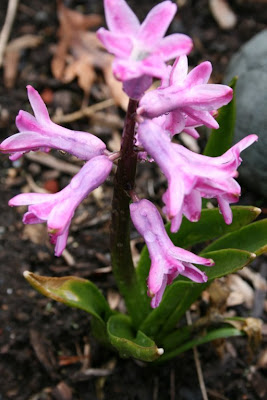
The other flowers in my garden are hellebores (third picture), periwinkle, violets, and pansies (fourth picture). The violets and pansies are good for tiny vases. I will use antique shot glasses or small maple syrup bottles we've collected from Cracker Barrel.
~
2. Cut Branches
~
I cut my trees and shrubs also. Now I have cherries, pussy willow, serviceberry, forsythia, quince, cornelian cherry, and redbud. Magnolia flowers are wonderful to float. I don't cut branches from magnolias because they tend to throw up long vertical branches if pruned. Floating in water, the flowers only last one to two days, but to see them up close I appreciate their beauty all the more and I can pick a few everyday that they are in bloom.
~
3. Foliage
~
I love the freshness of the early spring flowers. Often I make vase of only one type of plant all together. However, if I want foliage filler, I have celandine poppy, pussy willow, and bleeding hearts. The celandine poppy is one of the few perennial plants that has a lot of leaves. This is a member of the poppy family, so sear the stems before placing stems in water. Bleeding hearts have both beautiful leaves and flowers. The flowers have not yet appeared, but throughout its three month stay in the garden I use bleeding heart leaves as filler in vases.
~

Wednesday, April 16, 2008

Garden Bloggers' Bloom Day - April 2008: Spring Flowering Trees, Shrubs, Bulbs, and More in New Jersey (zone 6b)

Cornelian Cherry Dogwood

Crocuses
Forsythia
Serviceberry
Daffodils and Crocuses on Goldberry Hill
Hyacinth in the Bird Garden
Virginia Bluebells
Brunnera Macrophylla
Daffodils in the Cutting Garden
Self-Seeding Pansies
Vinca Minor or Lesser Periwinkle
Winter Honeysuckle
Andromeda
Violet

Search Heirloom Gardener

Google
 

Blogflux

Blog Flux Pinger - reliable ping service. Blog Directory Alltop, all the top stories
Powered By Blogger