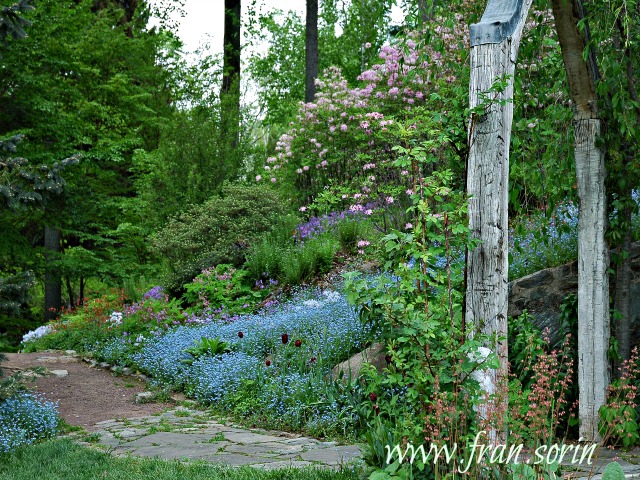
I was surprised and honored to be recognized by Jane Marie at Thyme of Herbs in her list of "10 Blogs That Have Raised The Bar On Garden Blogging." Janie Marie, thank you for your support and recognition!
Related post: Heirloom Gardener Featured on the Star-Ledger's NJ.com
Thursday, April 24, 2008
Thyme for Herbs: 10 Blogs That Have Raised The Bar On Garden Blogging


Wednesday, April 23, 2008
A Visit to Chanticleer in Wayne, Pennsylvania: Spring Bulbs, Flowering Trees, and Inspiring Containers
I have never been to Chanticleer in the spring. Usually, things are too busy here with spring sports and gardening to go for the day; but with a clear schedule, we went. It was wonderful.
 The most inspiring part of the visit was seeing all the containers. I often find spring pots hard to put together, but with a combination of colored branches from dogwoods and willows, climbing vines, leafy vegetables, and some flowering plants, each pot conveyed the fun and excitement of spring.


It was also good to see which annuals be set out early. Usually, I plant bulbs for most of my spring color in my beds, but I was inspired by Chanticleer to use some annuals such as the African daisy (Osteospermum) which can tolerate cool weather too.

Chanticleer's large drifts of bulbs (pictured) are a hint to the abundance of summer which will follow. I have not planted any bulbs in the lawn, but I'm thinking of doing so in the fall. My daughter loved that you could walk through the flowering bulbs as if they created a meadow. It is those kinds of romantic vignettes that make Chanticleer memorable.

In this trip, I was also able to see things which are more hidden later in the season. To see how hard they cut back their shrubs teaches me how much to cut mine back. I wanted to much a hill in our garden with pebbles, but I hesitated thinking that they would roll down. However, at Chanticleer there is a hill as steep or steeper than mine mulched with pebbles (pictured) and they are not all sitting at the bottom of the hill.
Related posts: Garden Color at Chanticleer and Early Spring Containers
Tuesday, April 22, 2008
Wall Street Journal & New York Times: Suburban Farming and Kitchen Gardens
Today, the Wall Street Journal featured an article and a video about individuals who have started to farm their own and their neighbors' suburban lots for food. Kelly Spors writes:
"Since 2006, Mr. Nash, 31, has uprooted his backyard and the front or back yards of eight of his Boulder neighbors, turning them into minifarms growing tomatoes, bok choy, garlic and beets. Between May and September, he gives weekly bagfuls of fresh-picked vegetables and herbs to people here who have bought "shares" of his farming operation. Neighbors who lend their yards to the effort are paid in free produce and yard work."
Last week, the New York Times also wrote an article about the less-extreme resurgence of kitchen gardens. Anne Raver writes:
"During World War I, to save fuel and labor, President Woodrow Wilson had sheep grazing on the White House lawn. His wife, Edith, planted vegetables to inspire the Liberty Garden campaign, in which thousands of students, called 'Soldiers of the Soil,' grew their own food in their schools and communities, she said. As the Allied powers began to win, the name Liberty Garden was changed to Victory Garden...Just after Pearl Harbor, Ms. Hayden-Smith said, another Victory Garden campaign was started. Eleanor Roosevelt grew peas and carrots on the White House lawn, and by the end of the war, Ms. Hayden-Smith said, 'Americans were producing 40 percent of the country’s produce' in their gardens' (emphasis added)."
Sunday, April 20, 2008
Cut Flowers, Branches, and Foliage: Bringing Early Spring Into The Home
 Cutting flowers from the garden is a beautiful way for me to bring the garden into the home. The flowers that we grow in the garden are incomparable to the ones at the florist or the supermarket. I thought this year I would keep of record of good cutting material--flowers and foliage. Almost anything can be used for arrangements, but often I overlook plants until I see a clever arrangement put together by someone else. So, please share with me the plants you like to cut and the combinations you enjoy.
~
1. Cut Flowers
1. Cut Flowers
~
I mainly have spring bulbs for cutting. These include snowdrops (first picture), crocuses, daffodils (first picture), hyacinth (second picture), and early tulips. All of the bulbs will last at least a week in water, if cut when they are just about to open except crocuses. Crocuses are short lived as a cut flower, lasting only several days. Daffodils I do not mix with other flowers because the sap which oozes out of the stem poisons other flowers. I have read that if you soak daffodils in many changes of water for many hours it renders them safe to mix with other flowers. I haven't taken the time to try this, so I don't know first hand how well it works.
I mainly have spring bulbs for cutting. These include snowdrops (first picture), crocuses, daffodils (first picture), hyacinth (second picture), and early tulips. All of the bulbs will last at least a week in water, if cut when they are just about to open except crocuses. Crocuses are short lived as a cut flower, lasting only several days. Daffodils I do not mix with other flowers because the sap which oozes out of the stem poisons other flowers. I have read that if you soak daffodils in many changes of water for many hours it renders them safe to mix with other flowers. I haven't taken the time to try this, so I don't know first hand how well it works.
~
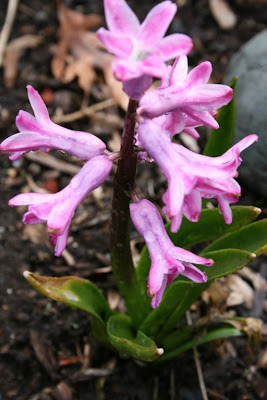 The other flowers in my garden are hellebores (third picture), periwinkle, violets, and pansies (fourth picture). The violets and pansies are good for tiny vases. I will use antique shot glasses or small maple syrup bottles we've collected from Cracker Barrel.
 The other flowers in my garden are hellebores (third picture), periwinkle, violets, and pansies (fourth picture). The violets and pansies are good for tiny vases. I will use antique shot glasses or small maple syrup bottles we've collected from Cracker Barrel.
~
2. Cut Branches
2. Cut Branches
~
I cut my trees and shrubs also. Now I have cherries, pussy willow, serviceberry, forsythia, quince, cornelian cherry, and redbud. Magnolia flowers are wonderful to float. I don't cut branches from magnolias because they tend to throw up long vertical branches if pruned. Floating in water, the flowers only last one to two days, but to see them up close I appreciate their beauty all the more and I can pick a few everyday that they are in bloom.
~
 3. Foliage
 3. Foliage
~
I love the freshness of the early spring flowers. Often I make vase of only one type of plant all together. However, if I want foliage filler, I have celandine poppy, pussy willow, and bleeding hearts. The celandine poppy is one of the few perennial plants that has a lot of leaves. This is a member of the poppy family, so sear the stems before placing stems in water. Bleeding hearts have both beautiful leaves and flowers. The flowers have not yet appeared, but throughout its three month stay in the garden I use bleeding heart leaves as filler in vases.
~

Wednesday, April 16, 2008
Garden Bloggers' Bloom Day - April 2008: Spring Flowering Trees, Shrubs, Bulbs, and More in New Jersey (zone 6b)
 Cornelian Cherry Dogwood

Crocuses
 Forsythia

 Forsythia

Serviceberry
 Daffodils and Crocuses on Goldberry Hill
 Hyacinth in the Bird Garden
 Virginia Bluebells
 Brunnera Macrophylla
 Daffodils in the Cutting Garden
 Self-Seeding Pansies
 Vinca Minor or Lesser Periwinkle
 Winter Honeysuckle
 Andromeda
 Violet
Related blog/posts: May Dreams Garden, Garden Bloggers' Bloom Day - March 2008, Early Spring Containers
Sunday, April 13, 2008
Gardening with Children: Ten Tips for Planning a Children's Garden
Creating a welcoming place for my children and their friends to play and enjoy nature while I pursue my favorite activity is one of the main goals as I develop my garden. After all, the more time they want to spend in the garden playing, the more time I get to garden. If you are planning a children's garden of your own, here are ten things to keep in mind.
. 1. Create areas that attract and encourage children to play. In the Walled Garden, my husband built an eight-by-eight foot sandbox. The kids love this, especially because its generous size allows them to build elaborate neighborhoods and landscapes in the sand. Also, around the sandbox is a sitting area for me to relax with them when I want. Adjacent to the sandbox is a digging area (pictured) that my children specifically requested. Children love to dig and get dirty and I do not want to find holes in my lawn or beds, so designating an area for this activity makes everyone happy.
. Next to the digging area in the Walled Garden is the fort. Play houses are great outdoor spaces for kids to play and hide. They give children a place of their own within the garden and are the center of many make believe games. Other ideas for play houses that I have seen are weeping trees that can be used as hide outs, sunflower houses, and outdoor teepees. Children want safe places to hide that are secret, but are not scary by being too out of the way or too dark. It reminds me of the toddler that walks away from you, but continues to look back every few steps to make sure you're still there. Along a section of our fence I planted four Lyland cypresses (pictured) to screen out our back neighbor who just removed a bunch of trees in the back of their property. These cypresses have turned out to be great hiding places, often serving as the 'secret passage from one land to another' or the 'other room.'
. 2. Accommodate the spaces where children naturally gravitate. One of my children's unexpectedly favorite places to play hide and seek, cops and robbers, and other made-up games is the miniature woodland (pictured) of Goldberry Hill. Here I have planted various shrubs, trees, and evergreens. Along one side of this woodland are tallish evergreens and twiggy shrubs that provide cover and privacy from the street. The other three sides open into the garden. Being in suburbia, my children to do not have the joy of really playing in the woods, but this provides them with a small taste.
. The area reminds me of the old fashioned shrubberies: it includes a climbing tree; shrubs which they can hide under like a mature weigela; airy, open evergreens that they can see through; and large, majestic white pines to sit under. The area is mainly planted with ground cover and daffodils. I keep the ground fairly clear of perennials so the children can fill free to run about among the trees and shrubs without any concern of stepping on small plants.
. 3. Leave some open space. There are some days when I want to plant every conceivable square foot of my property, but in the center of our back garden is an open lawn. I keep the lawn not because I love grass, but because it is a great place to hang our tree swing, play ball and lawn games, or to have a picnic. We also use this area as the place to pitch our tent when we do backyard camping during the summer. For a map of the open spaces and the gardens, click here.
 4. Make paths that allow the children to go where they want to go. Having paths in the garden that allow your children to easily and quickly go where they want to go is important if you do not want your beds and plants to get trampled. Some of the paths are grass, others just stepping stones, some mulch (pictured in the Children's Garden), and others stone. In addition, I have stepping stones within my borders which make it easy to retrieve lost balls or Frisbees without damaging the plantings.
. 5. Allow and encourage your children to garden with you. The importance of having children grow and tend plants within the garden cannot be over emphasized. It gives them great joy and a strong sense that this is their garden. Growing vegetables is an obvious place to start. Baby tomatoes, lettuce, sugar snap peas, pole beans, carrots, and cucumbers are all easy to grow, can be picked frequently, and eaten with little to no preparation. In the garden, you can grow unusual, heirloom varieties that are not at the grocery store. For example, my children love to grow lemon cucumbers (pictured) which look like a lemon, but taste like a cucumber. In addition, we usually grow several different leaf lettuces like Amish Deer Tongue or Red Velvet.
.
I also try to accept their help whenever they offer. I know that sometimes is won't be done 'right' and it will often take twice as long. Yet, the satisfaction they get from doing the job is beyond measure. I fondly remember how my son planted a baby lilac in a one gallon pot we bought from Doc Lilac in Rochester, New York. He must have been only five, but he dug the hole and planted it without any help from me. My son with pride recalls this every year when the lilacs come into bloom.
.
6. Allow them to cut flowers. Making bouquets of cut flowers is another way my children enjoy the bounty of the garden. They love making vases for our home and to give to friends. Inspired by Chanticleer, I always keep a large bowl filled with water in which we can float flowers and foliage from the garden. Even the youngest child can pick flowers by hand and create a floating arrangement. The children also know that they can use leaves and flowers from the garden in their games also. If they are having races, they feel free to make little crowns out of boxwood for the champions. They will use leaves to make landscapes is the sandbox. Our only rule is never always take from the same plant.
. 7. Plant to engage all of your children's senses.
.
*Touch - everyone loves stroking the leaves of lambs' ear (pictured) or verbascum bombyciferum
.
.
*Smell - scented leaves (costmary, mint, monarda, lavender) and flowers (roses, valerian, tuberose, daffodils, some irises, peonies, sweet bay magnolia, phlox, winter honeysuckle, abelia, hosta plantangiana, and lilies) are favorites
.
.
*Time - plants that tell time are fascinating for children, such as morning glories, moonflowers, four o'clocks, evening primrose, and daylilies
.
.
*Size - large leaves (brunnera, elephant ear) and flowers (sunflowers, dinner plate dahlias) are fun for kids
.
 8. Attract birds and butterflies to the garden.
*Gold Finches - purple coneflower, sunflowers
*Hummingbirds - honeysuckle, monarda, salvia, cardinal flower
*Butterflies - butterfly bush (pictured), phlox, daisies of all sorts, catmint, and lavender
 8. Attract birds and butterflies to the garden.
*Gold Finches - purple coneflower, sunflowers
*Hummingbirds - honeysuckle, monarda, salvia, cardinal flower
*Butterflies - butterfly bush (pictured), phlox, daisies of all sorts, catmint, and lavender
.
*Swallowtail and Monarch Caterpillars - butterfly weed, dill, and rue (the children love seeing them grow and mature until they make their chrysalis and become butterflies)
*Swallowtail and Monarch Caterpillars - butterfly weed, dill, and rue (the children love seeing them grow and mature until they make their chrysalis and become butterflies)
 9. Plant something in honor of each child. With the birth of a child, I always plant a rose in their honor. As they grow, they develop an attachment to it knowing that this is their rose. Pictured is my fourth child's rose in the Rose Garden.
.
10. Read some books on Children's Gardens. Some inspiring books on the subject are Molly Dannenmaier's A Child's Garden and Sharon Lovejoy's Roots, Shoots, Buckets & Boots and Sunflower Houses.
English Gardens: Christopher Lloyd's Great Dixter - the battle is won
Telegraph.co.uk reports: "Many in the gardening world are over-joyed at the news that Great Dixter, the Sussex garden made famous by Christopher Lloyd, has just received £4 million of Heritage Lottery funding...What is more surprising is the level of debate it has inspired, led by one of our greatest historians Sir Roy Strong, who cannot see the justification for keeping a garden going after the death of its owner." For the full story, click here.
Saturday, April 12, 2008
Container Gardening: Dan Benarcik of Chanticleer
 As I have previously written, I am a great fan of Chanticleer. As a part of Gardening Gone Wild's recent Garden Bloggers' Design Workshop on Container Gardening, there is a short post with insights from Dan Benarcik, the horticulturalist who designs many of Chanticleer's inspiring containers. Despite their "over the top couture" appearance, he does try to make their maintenance as simple as possible--planting once for the season, fertilizing once a month, and watering once a day.
Monday, April 07, 2008
Container Gardening: Early Spring Containers - Daffodils, Pansies, Lettuce, and Primrose
 As a follow-up to my recent Gardening Bloggers' Design Workshop post on the variety, soil, and care of containers, here are some pictures of this year's early spring containers. At this stage in the season, it still drops below freezing some nights, so I am limited in what I can plant.
 In the pot that is next to my front door (first picture), daffodils greet visitors. At the base of the daffodils, there is a ring of pansies and lettuce (see the detail in the second picture), an idea that I picked up from Chanticleer.
 In other containers that I am not yet ready to plant for the full season (such as my hanging baskets), I simply fill them with pansies--an idea that I picked up from the New York Botanical Garden (NYBG).

Sunday, April 06, 2008
Forced Branches: Follow-up Pictures of Cherry Blossoms
 As a follow-up to my prior posts on forced forsythia, crabapple, quince, ceris (redbud), and pussy willow, here are two pictures of the current forced branches gracing my family room: cherry.
I don't have a cherry tree in my own garden, but purchased these beautiful branches from a local grower. From the time of purchase, it took about a week or so for the buds to swell and another week for them to fully blossom.
Cherry is one of several trees--dogwood, magnolia, and witch hazel are the others--that I have a great desire to add to my garden this year. 
Saturday, April 05, 2008
Garden Planning: A Map of My Gardens
 Over the past seven years, I have tried to make the most of every available space in which to garden on our property. In response to some reader requests about how I fit so many different gardens on less than half an acre and for my own garden planning, I asked my husband to draw a map of our property highlighting the various gardens.
The entire space is 100 feet wide and 200 feet deep. The front of our home faces southeast towards the street. The street is the highest point on our property and from there slopes downward. The map is drawn roughly to scale, each square representing five feet.
In the front, gardens welcome visitors as they walk down to our home: Goldberry Hill, the Front Border, and the Egg Garden.
On the side, gardens occupy previously unused space: the Cutting Garden and the Rose Garden.
In the back, gardens border a large open lawn where the children play (clockwise from the Rose Garden): the Children's Garden, the Triangle Garden, the Long Border, the Walled Garden (includes the sandbox and is bordered by the fort), the Winter Border (this year's major garden installation), the Bird Garden, and Lilac Hill. The custom deer fence completely encloses all of these gardens and the Rose Garden.
Related Posts: How to Keep a Garden Journal and Creating Space for a Garden - the Cutting Garden
Tuesday, April 01, 2008
Old Farmer's Almanac: Spring Planting Schedule (April) and Heirloom Seed Sources
 I finally got to planting out my vegetables with the kids this weekend in the Children's Garden. According to the Old Farmer's Almanac, I made it just under the wire to plant many of my spring crops. In the early vegetable raised bed, I planted beets, onions, leeks, Swiss chard, carrots, lettuce, sugar snap peas, and broccoli raab.
In zone 6b, beets, broccoli, carrots, lettuce, parsley, onion sets, peas, and turnips need to be done now. The vegetables which can be started now until early to mid April are brussel sprouts, cabbage, cauliflower, collards, kale, leeks, radishes, spinach, and Swiss chard. I have planted a mix of heirloom and modern hybrids. The following are the heirloom varieties I've sown:
- Lettuce Mix from Seed Savers Exchange of Amish Deer Tongue, Australian Yellowleaf, Bronze Arrowhead, Forellenschuss, Lolla Rossa , Pablo, Red Velvet, and Reine des Glaces
- Bull's Blood Beet purchased from Thomas Jefferson's Monticello; the Monticello online store is a good source of heirloom early American plants and seeds
- Nantes Carrot, also from Seed Savers Exchange; "Seed Savers Exchange is a nonprofit organization that saves and shares the heirloom seeds of our garden heritage, forming a living legacy that can be passed down through generations"
Related posts: How to Build Raised Vegetable Beds; Organically Preparing the Soil for Vegetable Planting; and Old Farmer's Almanac Gardening 2008 Calendar
Follow-up: Old Farmer's Almanac Spring Planting Schedule (May)
Subscribe to:
Posts (Atom)
Blogflux